
7,000 km / month
Drip Lateral Systems
Inline drip lateral to IS 13488:2008 — 12, 16, 20 and 25 mm across four pressure classes, produced at 200 metres a minute, delivering water where the crop actually needs it.
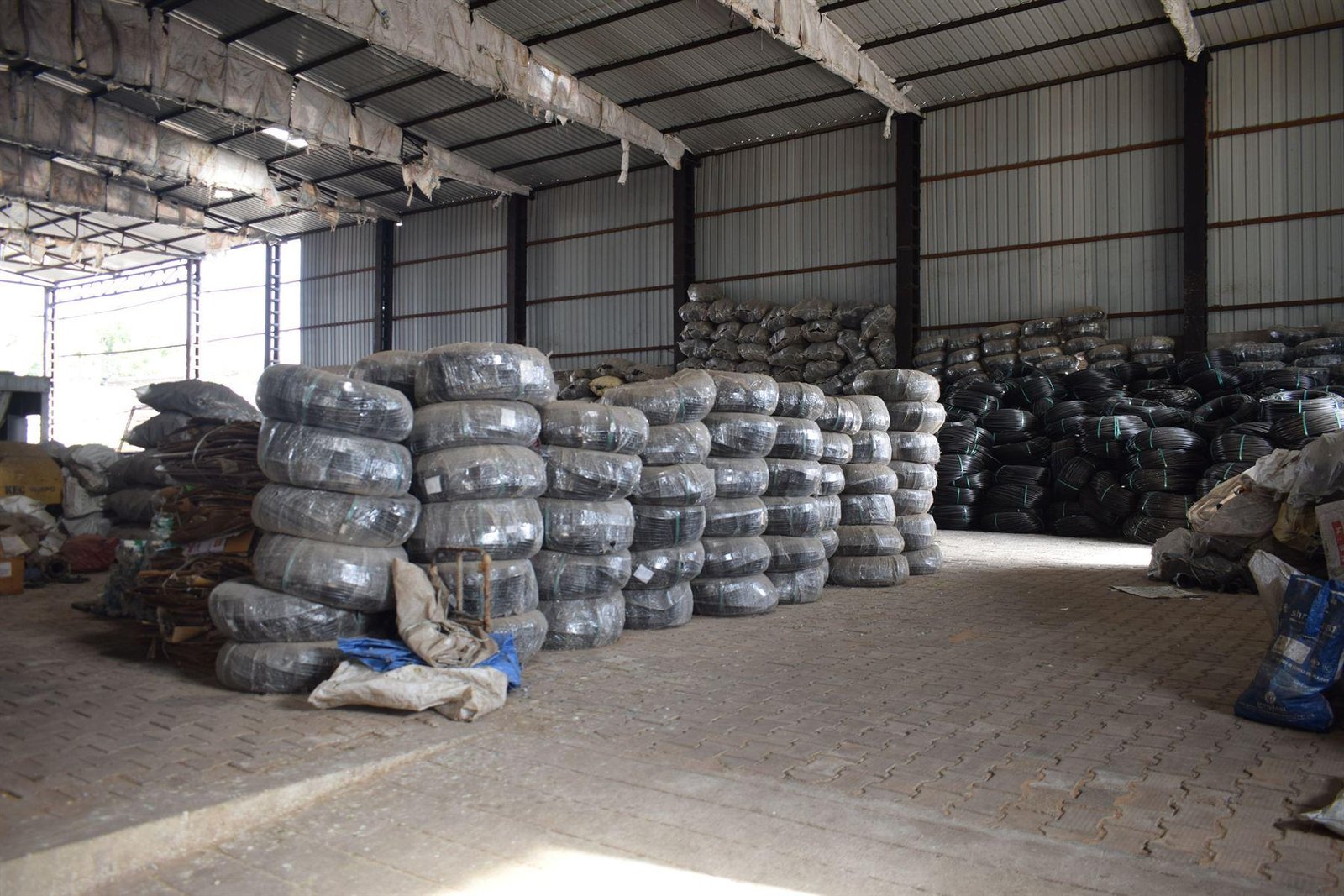
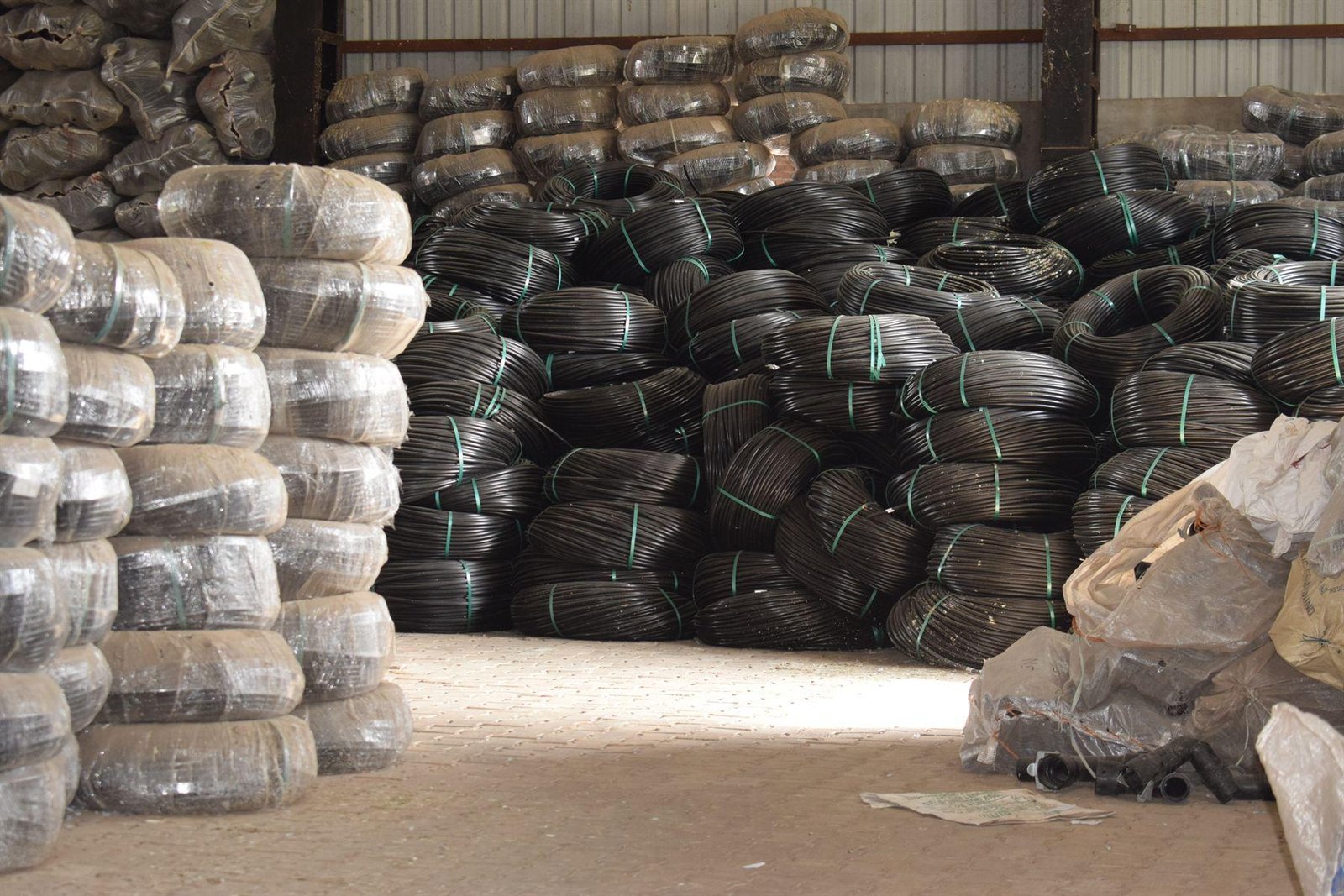
Drip lateral coils in the store
Overview
The highest-volume line on the campus.
Aligned to ISO 9261, in four pressure classes.
Category and coefficient of variation stated, not implied.
More crop per drop.
Drip lateral is the highest-volume product on the campus by length. At 200 metres a minute the line turns out roughly 7,000 kilometres a month, most of it going into field irrigation across northern India.
The engineering that matters in drip is unglamorous: consistent dripper spacing, uniform discharge along the run, and wall thickness that survives being laid, lifted and relaid across seasons. Those are extrusion-control problems, and they are the same ones we solved for cable.
Technical data
Specification.
Built to the purchaser's schedule. Fields marked On enquiry are issued against a specific enquiry. Delivery as per the client's requirement, confirmed with the quotation. Open the rows below for construction details, reference tables and fittings.
General
| Parameter | Specification |
|---|---|
| Product | Inline emitting pipe (drip lateral) |
| Standard | IS 13488:2008, aligned to ISO 9261:2004 |
| Nominal diameters | 12, 16, 20 and 25 mm |
| Pressure classes | Class 1 (0.100 MPa), Class 2 (0.125 MPa), Class 3 (0.250 MPa), Class 4 (0.400 MPa) |
| Production rate | 200 metres per minute |
| Monthly capacity | Approximately 7,000 km |
| Dripper spacing | Standard ladder from 15 cm to 150 cm — specify |
| Nominal discharge | 0.8, 1.2, 1.6, 2.0 and 4.0 litres per hour at 1 bar — specify |
Performance
| Parameter | Specification |
|---|---|
| Uniformity category | Category A (±5%, CV ≤ 5%) or Category B (±10%, CV ≤ 10%) |
| Emitter type | Inline, unregulated (non pressure-compensating) or regulated (pressure-compensating) |
| Emitter flow exponent | Below 0.3 for unregulated; below 0.2 for pressure-compensating |
| Nominal test pressure | 100 kPa (1 bar) |
| Filtration required | 75 to 100 micron — that is 160 to 200 mesh |
| Marking | Flow direction arrows at intervals not exceeding 5 metres, per IS 13488 cl. 10 |
| Coil lengths | On enquiry — standard coil lengths on enquiry |
Reference data — what the standards requireTables from the Indian Standard, for checking any quotation against it
Dimensions and pressure classes
| Nominal OD mm | Inside diameter mm | Class 1 0.100 MPa | Class 2 0.125 MPa | Class 3 0.250 MPa | Class 4 0.400 MPa |
|---|---|---|---|---|---|
| 12 | 10.50 ± 0.20 | 0.4 – 0.5 | 0.6 – 0.7 | 0.8 – 1.0 | 1.1 – 1.3 |
| 16 | 14.20 ± 0.20 | 0.5 – 0.6 | 0.7 – 0.9 | 1.0 – 1.2 | 1.3 – 1.5 |
| 20 | 18.00 ± 0.20 | 0.7 – 0.8 | 0.9 – 1.1 | 1.2 – 1.4 | 1.5 – 1.7 |
| 25 | 22.60 ± 0.20 | 0.9 – 1.1 | 1.2 – 1.4 | 1.5 – 1.7 | 1.8 – 2.2 |
Wall thickness in millimetres. Note that IS 13488 fixes the inside diameter and derives the outside diameter — the opposite convention from IS 4984 for HDPE pipe. Getting this the wrong way round is a common error on specification sheets.
Uniformity categories
| Category | Mean deviation from nominal discharge | Coefficient of manufacturing variation |
|---|---|---|
| Category A | ± 5% | ≤ 5% |
| Category B | ± 10% | ≤ 10% |
This is the number that decides whether the far end of a run gets the same water as the near end. Ask any supplier for the category and the measured CV, not for an adjective.
Standard and optional fittingsWhat is supplied as standard, and what is available to order
System components
Supplied alongside
- Inline drip lateral in all four classes
- HDPE mains and sub-mains
- Mini sprinkler systems
- Fittings, connectors and end caps
- Filtration to 75–100 micron as the standard requires
- Design support for field layout
Why drip
Against flood irrigation
- Water delivered to the root zone, not the field surface
- Sharp reduction in evaporation and runoff losses
- More uniform application across undulating ground
- Fertigation possible through the same network
- Lower pumping energy per irrigated hectare
- Eligible under state and central micro-irrigation subsidy schemes
Compliance
Standards & testing.
Routine tests are performed on every unit before dispatch. Type tests are certified from CPRI, ERDA or NABL-accredited laboratories on request.
| Standard | Scope |
|---|---|
| IS 13488:2008 | Irrigation equipment — emitting pipe systems, aligned to ISO 9261:2004 |
| IS 13487 | Irrigation equipment — emitters, for emission rates up to 15 litres per hour |
| IS 13479 | Irrigation equipment — pull-out resistance of mechanical joint fittings |
| IS 12786 | PVC pipes for irrigation — referenced for environmental stress cracking |
| ISO 9261:2004 | Agricultural irrigation equipment — emitters and emitting pipe |
Routine and type testsPerformed on every unit, and available on request
Routine tests
Performed on every unit
- Uniformity of emission rate at nominal pressure
- Emission rate against inlet pressure on four emitting units
- Wall thickness and inside diameter against IS 13488 Table 1
- Hydrostatic pressure resistance at ambient and at 60 °C
- Tension resistance at 50 °C
- Pull-out resistance at fittings — IS 13479
- Environmental stress cracking — IS 12786 Annex D
- Emitting unit flow exponent
Purchaser and third-party pre-dispatch inspection is accommodated on request, including for export consignments. Type-test certificates are issued from CPRI, ERDA or NABL-accredited laboratories — copies available on request.
Inside the works
In the field.
Laterals laid across cropped beds, running at design discharge.
Walk the whole works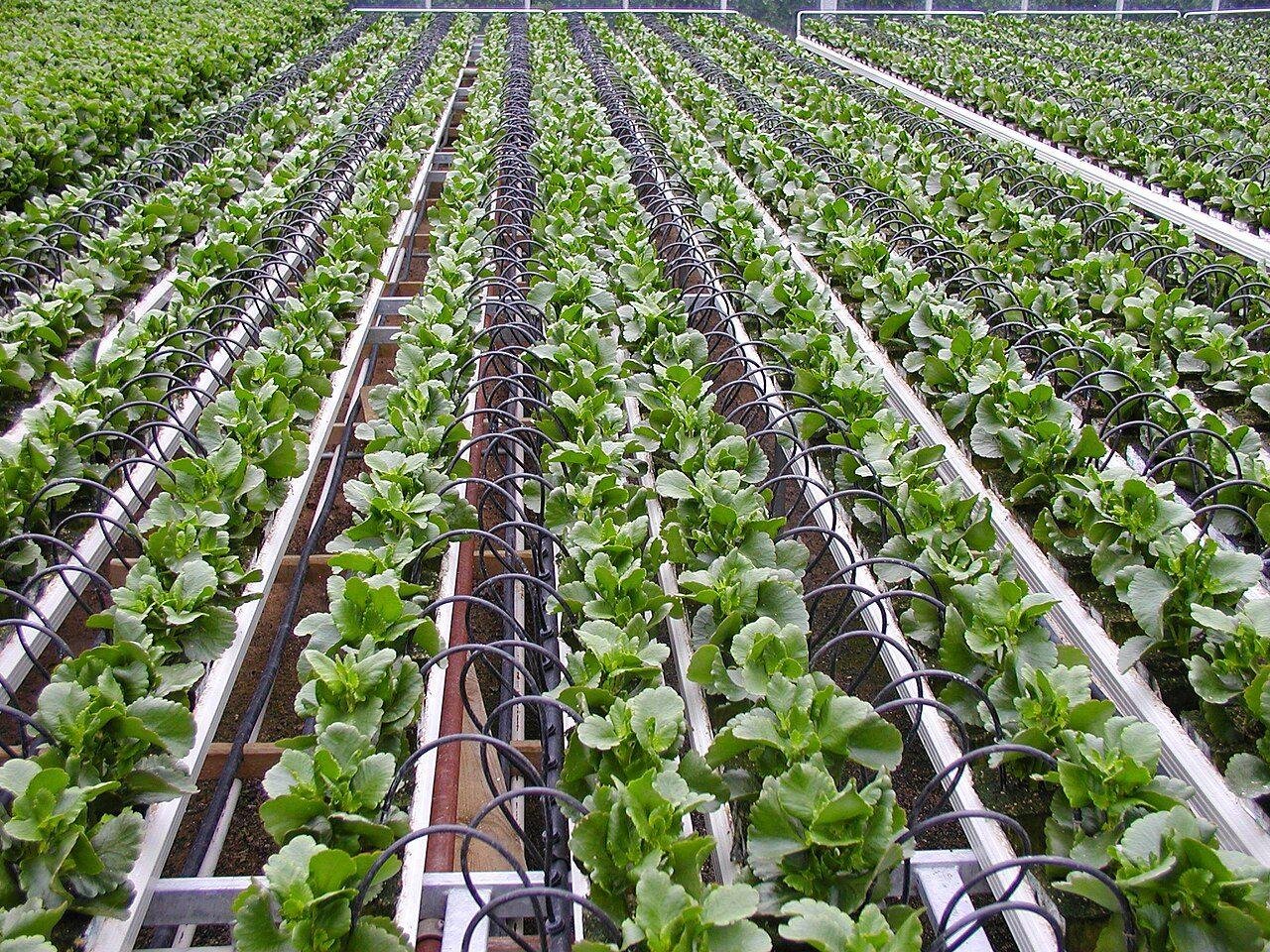
Applications
Where it goes to work.
Row crops
Cotton, sugarcane, maize and vegetable production.
Orchards
Fruit and plantation crops on wide spacing.
Greenhouse
Polyhouse and shade-net cultivation.
Micro-irrigation programmes
Supply under state and central subsidy schemes.
Questions
Frequently asked.
What filtration does drip lateral need?
What is the difference between pressure-compensating and non-compensating drippers?
Which dripper spacing should I choose?
What is CVm and why does it matter?
Often supplied together
Talk to us about drip supply.
Whether you need bulk lateral, a dealership or a designed field system, send us the crop, area and water source.