
Up to 20 MVA
Solar & Inverter Duty Transformers
Inverter duty transformers for solar and wind generation up to 20 MVA — dual-secondary step-up units with electrostatic shielding, de-rated core flux and windings designed for the harmonic spectrum an inverter actually produces.
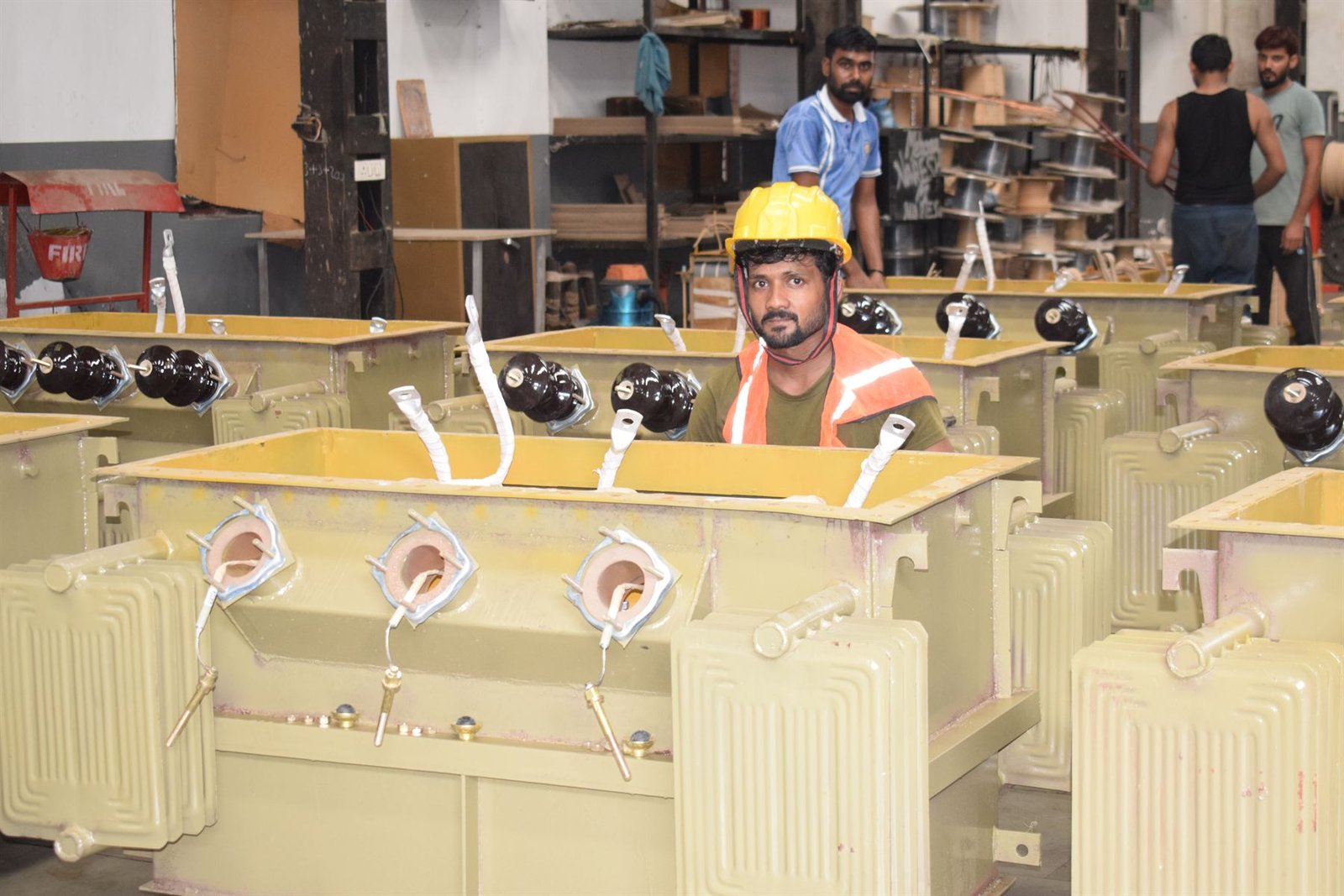
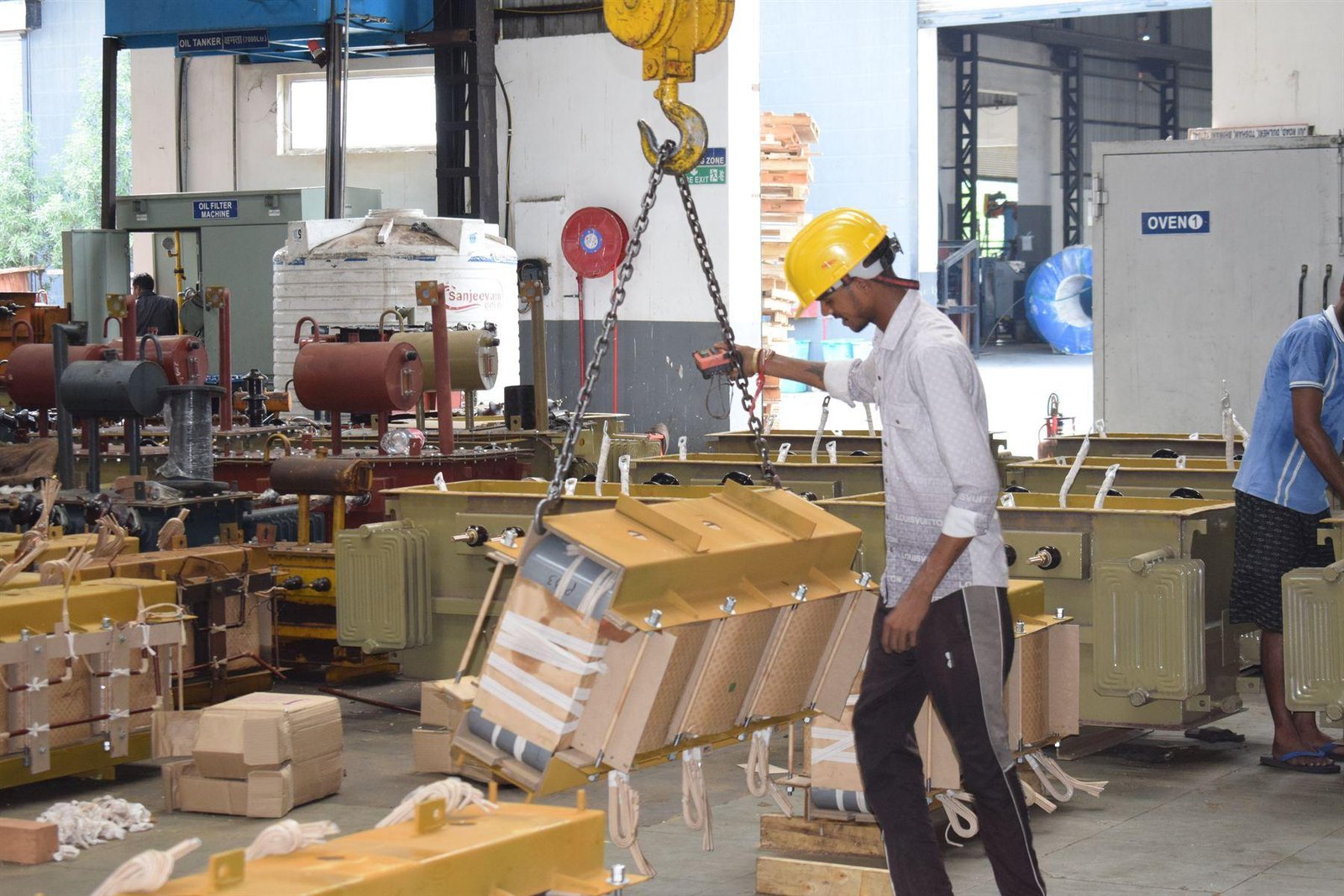
Tanks awaiting core-and-coil assembly
Overview
Two LV windings, each typically rated at half the total, decoupled by design.
Designed against the inverter's harmonic spectrum, not a sine wave.
Copper electrostatic shield between HV and each LV winding.
A solar transformer is not a distribution transformer with a different label.
An inverter feeds the transformer a non-sinusoidal current with significant harmonic content, and it does so on a duty cycle that is de-energised for roughly half the year. Both facts change the design.
Harmonic currents drive eddy-current heating in the windings that a standard design does not allow for, so conductors are transposed and the core flux density is de-rated to leave headroom. The overnight de-energised period means no-load loss dominates lifetime energy cost far more than it does on a distribution feeder — which is why the low-no-load-loss design is worth paying for here and not always elsewhere.
Technical data
Specification.
Built to the purchaser's schedule. Fields marked On enquiry are issued against a specific enquiry. Delivery as per the client's requirement, confirmed with the quotation. Open the rows below for construction details, reference tables and fittings.
General
| Parameter | Specification |
|---|---|
| Rated power | Up to 20 MVA |
| HV voltage | 11 kV or 33 kV |
| LV voltage | 315 / 380 / 415 / 480 / 600 / 690 / 800 V — the inverter output, not 433 V |
| Winding arrangement | Two, three or more secondaries; dual secondary is the norm |
| Duty | Step-up, outdoor, solar or wind generation |
| Frequency | 50 Hz standard; 60 Hz for export |
| Cooling | ONAN or ONAF; KNAN with ester fluid to order |
| Applicable standards | IS 2026, IS 1180, IEC 60076, IEEE C57.110, IEEE C57.159 |
Electrical
| Parameter | Specification |
|---|---|
| Vector group | YNd11d11 or Dyn11yn11 for dual secondary; Dyn11, YNd11, Dyn5, Yzn11 to order |
| Impedance HV–LV | Typically 7% to each LV winding |
| Impedance LV1–LV2 | Typically 11% or above — this is what decouples the two inverters |
| Harmonic design basis | Designed for the inverter harmonic spectrum, minimum 5% THD, with 3rd and 5th harmonic suppression |
| Harmonic derating | Per IEEE C57.110 — supply the inverter's harmonic spectrum with your enquiry |
| Electrostatic shield | Copper shield between HV and each LV winding, each brought out to its own 1.1 kV terminal |
| Core flux density | De-rated for harmonic headroom |
| Tapping | Off-circuit ±5% or ±10% in 2.5% steps; on-load to order |
| Temperature rise | 50 K top oil / 55 K winding over 50 °C ambient, allowing for harmonic heating |
| Zero-sequence impedance | To customer requirement |
Construction and further particularsMaterials, tank, paint and mechanical details
Construction
| Parameter | Specification |
|---|---|
| Windings | Transposed or continuously-transposed electrolytic copper, to limit eddy-current heating |
| Core | CRGO silicon steel to IS 3024, low-loss grade |
| Insulating fluid | Mineral oil to IS 335; natural or synthetic ester to IEC 62770 on request |
| Reverse power flow | Designed for continuous reverse power flow from the inverter side |
| Overload | Continuous overload capability at low ambient — state your site profile |
Reference data — what the standards requireTables from the Indian Standard, for checking any quotation against it
Why the numbers differ from a standard transformer
| Parameter | Standard distribution unit | Inverter duty unit |
|---|---|---|
| LV voltage | 433 V | 315 V to 800 V — set by the inverter |
| Vector group | Dyn11 | YNd11d11 or Dyn11yn11 for dual secondary |
| Secondaries | One | Two or more, each typically half the total rating |
| LV1–LV2 impedance | Not applicable | 11% or above, to decouple the inverters |
| Current waveform | Substantially sinusoidal | Non-sinusoidal, minimum 5% THD design basis |
| Core flux density | Full design value | De-rated to leave harmonic headroom |
| Winding conductor | Layer or helical | Transposed to limit eddy-current heating |
| Electrostatic shield | Not fitted | Copper shield per LV winding, individually terminated |
| Dominant lifetime loss | Load loss | No-load loss — the plant is de-energised around half the year |
This is the comparison to put in front of a developer who has been quoted a standard transformer for an inverter application.
Standard and optional fittingsWhat is supplied as standard, and what is available to order
Scope
What we supply
- Solar and wind step-up transformers to 20 MVA
- Dual, triple and multi-secondary configurations
- Electrostatic shielding, individually terminated
- Ester-filled units where fire performance matters
- Auxiliary transformers for plant supply
- Matched to the inverter OEM's harmonic spectrum
- Type-tested designs for dynamic and thermal short circuit
Send us this
What we need to quote
- Rated power and HV system voltage
- Inverter LV output voltage and number of inverters per transformer
- The inverter's harmonic spectrum, or the OEM and model
- Required LV1–LV2 impedance, if specified
- Vector group and tapping range
- Site ambient, altitude and pollution level
- Whether ester fluid is required
- Applicable standard — IS, IEC or IEEE
Compliance
Standards & testing.
Routine tests are performed on every unit before dispatch. Type tests are certified from CPRI, ERDA or NABL-accredited laboratories on request.
| Standard | Scope |
|---|---|
| IS 1180 (Part 1):2014 | Outdoor oil-immersed distribution transformers up to 2500 kVA, 33 kV — including the energy-efficiency levels |
| IS 2026 (Parts 1–5) | Power transformers — general, temperature rise, insulation levels, terminal markings, short-circuit withstand |
| IEC 60076 series | International power transformer standard — the export equivalent |
| IS 3024 | Cold-rolled grain-oriented (CRGO) electrical steel sheet and strip |
| IS 335:2018 | Insulating mineral oil for transformers and switchgear |
| IS 3639:1966 | Fittings and accessories for power transformers |
| IS 2099 / IS 7421 | HV and LV porcelain bushings |
| IS 3637 | Gas-and-oil-operated (Buchholz) relays |
| IS 5:2007 | Colours for ready-mixed paints — shade 631 for distribution, 632 Admiral Grey for power |
| IS 6600:1978 | Guide for loading of oil-immersed transformers |
| IEEE C57.110 | Establishing transformer capability when supplying non-sinusoidal load currents |
| IEEE C57.159 | Guide on transformers for distributed photovoltaic power generation systems |
| IEC 62770 | Unused natural esters for electrotechnical applications |
Routine and type testsPerformed on every unit, and available on request
Routine tests
Performed on every unit
- Winding resistance at each tap — IS 2026 (Part 1) cl. 16.2
- Voltage ratio, polarity, phase sequence and vector group — cl. 16.3
- Short-circuit impedance and load loss at 50% and 100% — cl. 16.4
- No-load loss and no-load current at 90%, 100% and 112.5% voltage — cl. 16.5
- Insulation resistance — cl. 16.6
- Separate-source voltage withstand — IS 2026 (Part 3) cl. 10
- Induced overvoltage withstand — IS 2026 (Part 3) cl. 11
- Pressure test — IS 1180 (Part 1) cl. 21.5.1.2
- Oil leakage test — IS 1180 (Part 1) cl. 21.5.1.3
- Oil breakdown voltage and moisture content — IS 335:2018
Type & special tests
Available on request
- Lightning impulse test — IS 2026 (Part 3) cl. 12
- Temperature-rise test — IS 2026 (Part 2) cl. 4
- Short-circuit withstand — IS 2026 (Part 5)
- Sound level determination — IS 2026 (Part 10)
- Paint adhesion, cross-hatch — ASTM D3359
- Magnetic balance test, HV and LV — CBIP Publication 317
- IP55 verification of cable box — IS/IEC 60529
Purchaser and third-party pre-dispatch inspection is accommodated on request, including for export consignments. Type-test certificates are issued from CPRI, ERDA or NABL-accredited laboratories — copies available on request.
Inside the works
Built on the same lines.
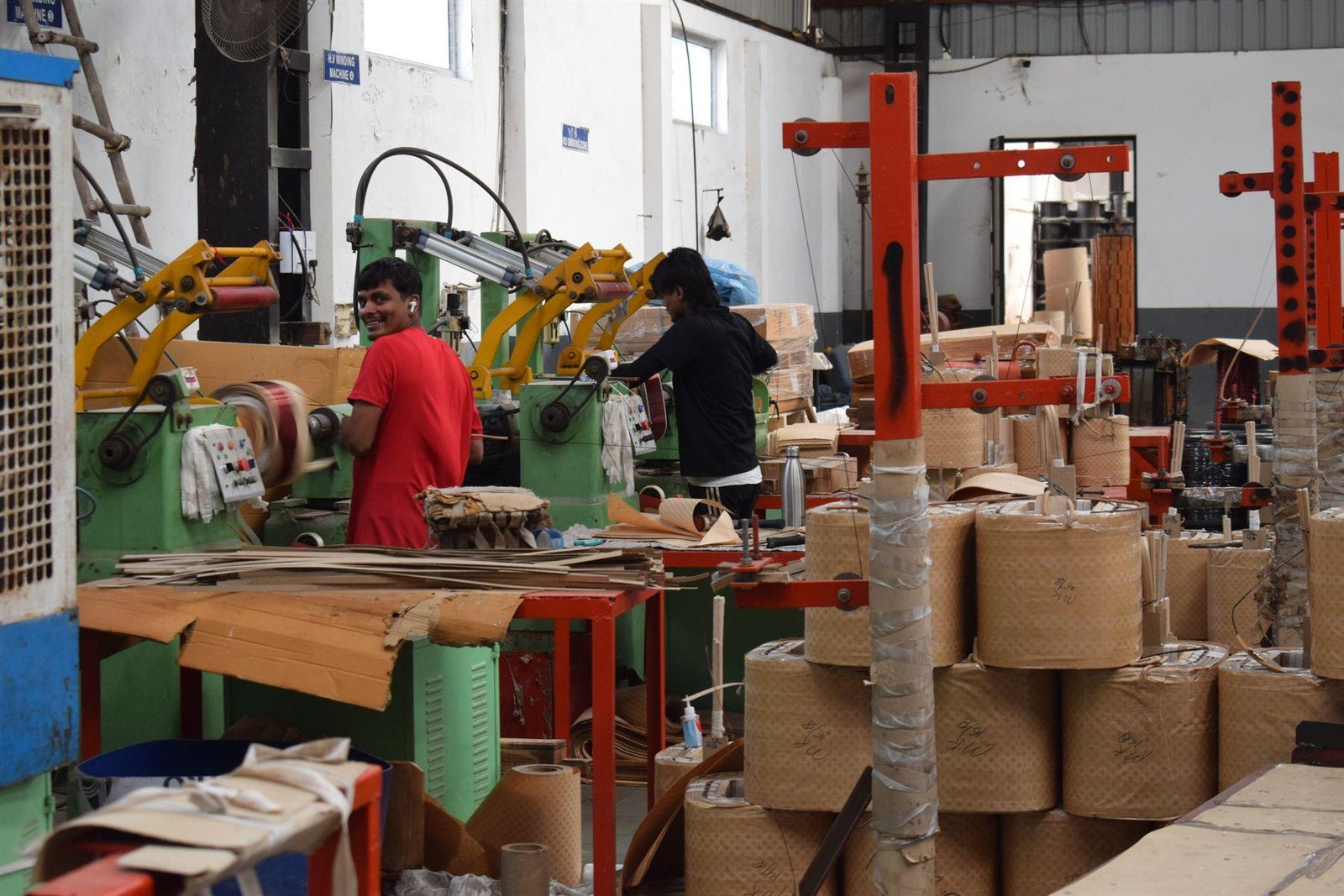
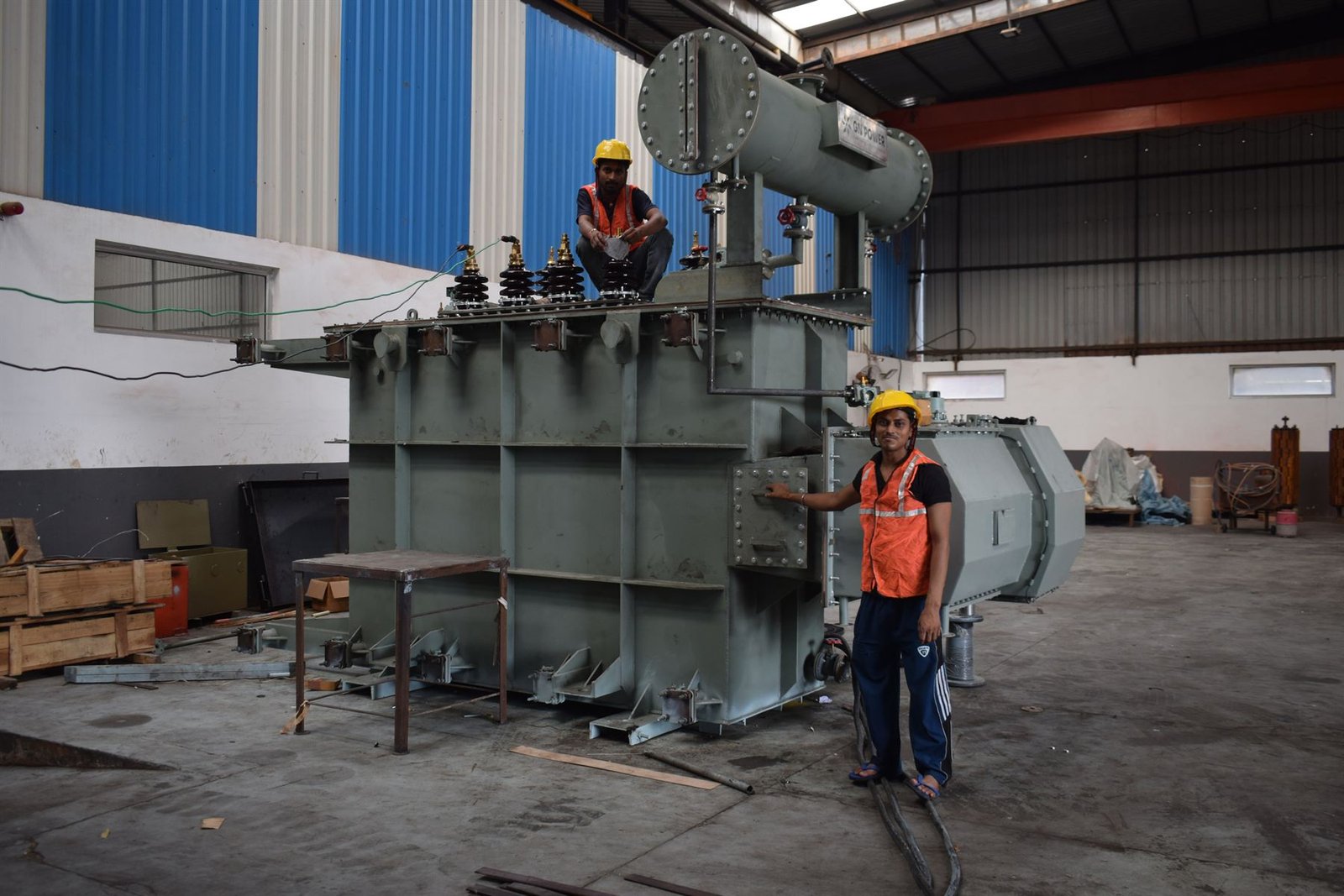
Inverter duty units are fabricated, painted and assembled alongside the distribution and power range.
Walk the whole works

Applications
Where it goes to work.
Utility-scale PV
Inverter step-up duty at ground-mounted solar plants.
Rooftop and C&I
Smaller step-up units for commercial and industrial rooftop systems.
Wind generation
Step-up duty at wind farms.
Storage and hybrid
Plants combining generation with battery storage.
Questions
Frequently asked.
What is an inverter duty transformer?
Why does the LV1 to LV2 impedance matter?
Do you publish a K-factor?
Can you supply ester-filled solar transformers?
Often supplied together
Sizing a solar step-up transformer?
Send us the plant rating, inverter model and LV voltage, and we will come back with a configuration, an impedance schedule and a price.