Micro-irrigation is usually presented as a single choice against flood irrigation. In practice most holdings need both drip and sprinkler zones, and choosing wrongly between them wastes money in ways that are not obvious until the season is underway.
The basic difference
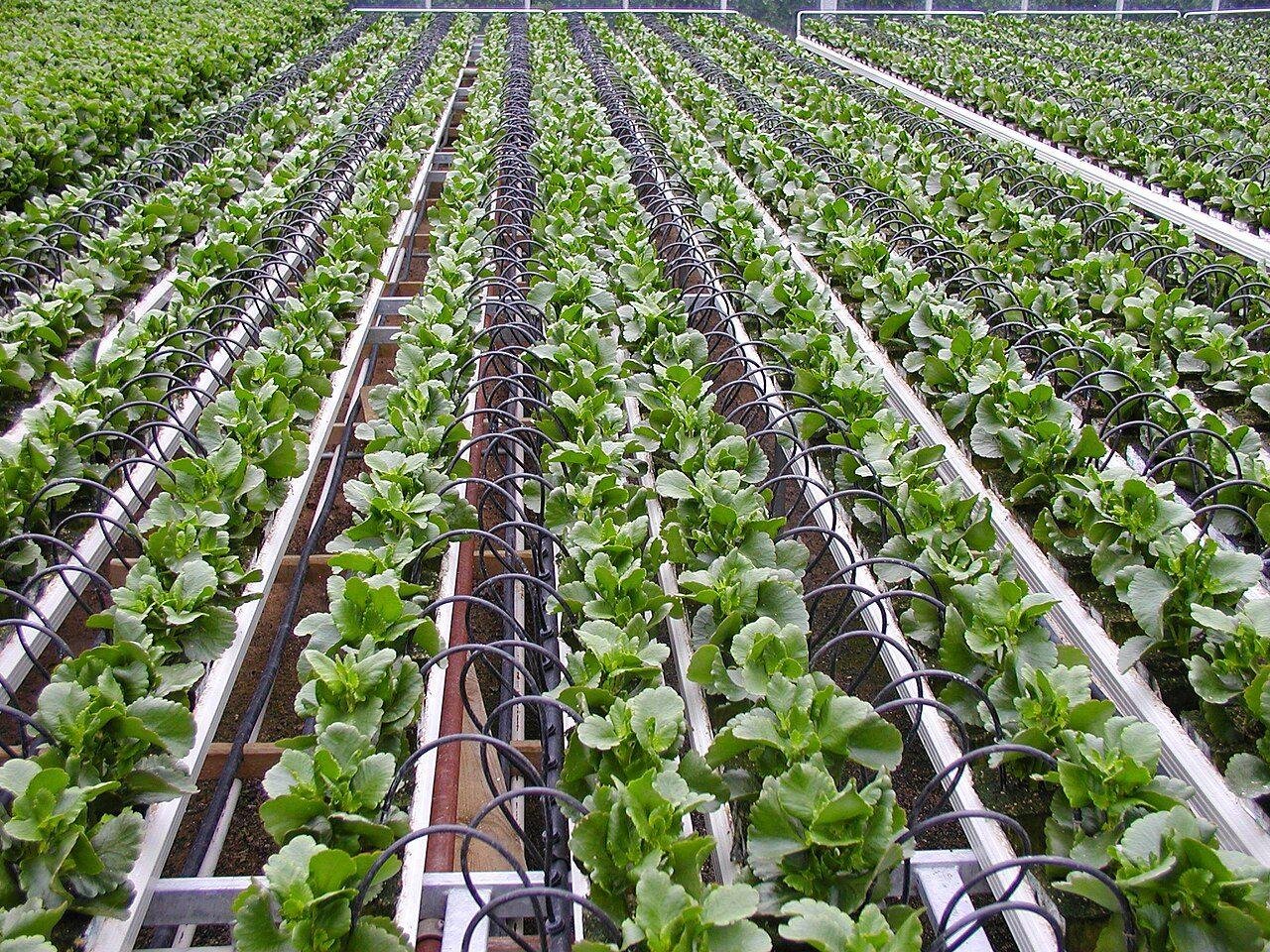
Drip delivers water to a point at the root zone. Mini sprinklers wet an area. That one distinction drives everything else.
| Consideration | Drip lateral | Mini sprinkler |
|---|---|---|
| Water delivery | To a point at the root zone | Even wetted area across the zone |
| Best suited to | Row crops, orchards, wide spacing | Nurseries, leafy and close-spaced crops |
| Operating pressure | About 1 bar | 1 to 3 kg/cm² |
| Filtration | 75–100 micron (160–200 mesh) | 100 micron |
| Evaporation loss | Lowest | Higher than drip, far lower than flood |
| Germination and establishment | Poor — wets only a point | Good — wets the whole bed |
| Frost and cooling use | Not suitable | Suitable |
Get the filtration right or nothing else matters
IS 13487 requires a filter of nominal aperture 75 to 100 micron — that is 160 to 200 mesh — for drip emitters. Note this is tighter than the 120-mesh figure that circulates widely in the market. Under-filtering is the single most common cause of dripper blockage, and a blocked run is invisible until the crop shows it.
The uniformity number to ask for
IS 13488 defines two categories of emitting pipe:
| Category | Mean deviation from nominal discharge | Coefficient of manufacturing variation |
|---|---|---|
| Category A | ± 5% | ≤ 5% |
| Category B | ± 10% | ≤ 10% |
This is what decides whether the last plant on a 60 metre run gets the same water as the first. It is also the number that neither of the two largest drip brands in India publishes on their product pages — both describe their uniformity with an adjective instead. Ask any supplier, including us, for the category and the measured coefficient of variation. A supplier who cannot give you a number does not measure it.
Pressure-compensating or not
A pressure-compensating dripper holds near-constant discharge across a stated pressure range. A non-compensating one does not, so discharge falls along the run and changes with slope. The technical discriminator is the flow exponent: below 0.2 for pressure-compensating, below 0.3 for unregulated.
If your field is flat and runs are short, non-compensating is cheaper and perfectly adequate. On undulating ground or long runs, pay for pressure compensation — the uniformity you lose otherwise costs more than the drippers.
A standards correction worth knowing
Many Indian mini sprinkler datasheets cite IS 12232. That is the wrong standard. IS 12232 (Part 1) covers rotating sprinklers — the impact sprinklers used in overhead sprinkler irrigation. The standard for micro and mini sprinklers is IS 14605, aligned to ISO 8026.
It is a small thing, but a datasheet with the wrong standard number on it tells you something about how carefully the rest of it was written.
Reading a dripline model code
The industry convention encodes size and wall thickness into the model number. A code like 16010 reads as 16 mm outside diameter with a 1.00 mm wall. 20012 is 20 mm with a 1.20 mm wall. Once you know that, a catalogue becomes self-documenting.
One convention trap: IS 13488 fixes the inside diameter of emitting pipe and derives the outside diameter — the opposite of IS 4984 for HDPE pipe, which fixes the outside diameter. Specification sheets get this backwards regularly.