Most distribution transformer enquiries arrive with a rating, a voltage ratio and a quantity. Those three lines are necessary and nowhere near sufficient. Here is what else belongs in the schedule, and why each item changes either the price or the suitability of what you get.
Vector group
IS 1180 mandates Dyn11 for three-phase distribution transformers — delta on the HV side, star with the neutral brought out on the LV side. Dyn1 is permitted as an alternative by agreement. If your network has an existing paralleling requirement, the vector group is not negotiable and must be stated. If it does not, Dyn11 is the right default and you should say so rather than leaving it blank.
Impedance
IS 1180 fixes impedance by rating band: 4.50% up to 630 kVA, 5.00% from 800 to 1250 kVA, and 6.25% from 1600 to 2500 kVA, with a ±10% tolerance. Most DISCOM specifications tighten this to “±10%, no negative tolerance”, because a lower impedance means a higher fault current at the LV terminals. If your protection coordination depends on a particular value, state it and state the tolerance you will accept.
Losses and the efficiency level
Specify the IS 1180 energy efficiency level and the amendment number, and ask each bidder to state guaranteed no-load and load loss separately. The reason for asking separately is that the two behave very differently over a transformer's life: no-load loss runs 8,760 hours a year regardless of loading, while load loss varies with the square of the load. On a lightly loaded rural feeder, no-load loss dominates lifetime cost by a wide margin.
Winding material
Copper or aluminium. Copper is denser in conductivity terms, so a copper-wound unit is physically smaller for the same losses; aluminium is cheaper per kilogram. Where a tender penalises load losses heavily, copper usually wins on total evaluated cost. State which you require — leaving it open makes bids non-comparable.
Tapping range
IS 1180 gives four tap positions at +2.5% to −5% for units up to 200 kVA, and seven positions at +5% to −10% above that, all in 2.5% steps. DISCOM variants are common — +5% to −7.5%, or +5% to −15% on larger ratings. If your feeder voltage regularly runs low, the tap range matters more than almost anything else on this list.
Fittings: standard against optional
IS 1180 Clause 20 splits fittings into standard and optional. Standard includes earthing terminals, rating plate, oil level gauge, breather, thermometer pocket, lifting lugs, pressure relief above 200 kVA, and Buchholz above 1000 kVA. Optional includes lightning arrestors, bird guards, temperature indicators, magnetic oil level gauge, anti-theft fasteners and rollers.
The items most often forgotten and then argued about after delivery are the LV cable box, the terminal connectors and the anti-theft fasteners. List them explicitly.
Testing and inspection
Routine tests are performed on every unit and their scope is fixed by IS 1180 Clause 21. What varies — and what you should specify — is the type test position: which tests, from which laboratory, and how recent. Most Indian DISCOMs require type test certificates from CPRI, ERDA or an NABL-accredited laboratory, not older than five years at bid opening. Short-circuit withstand is the test most bidders cannot show, and the one that most often decides a pre-qualification.
Painting and finish
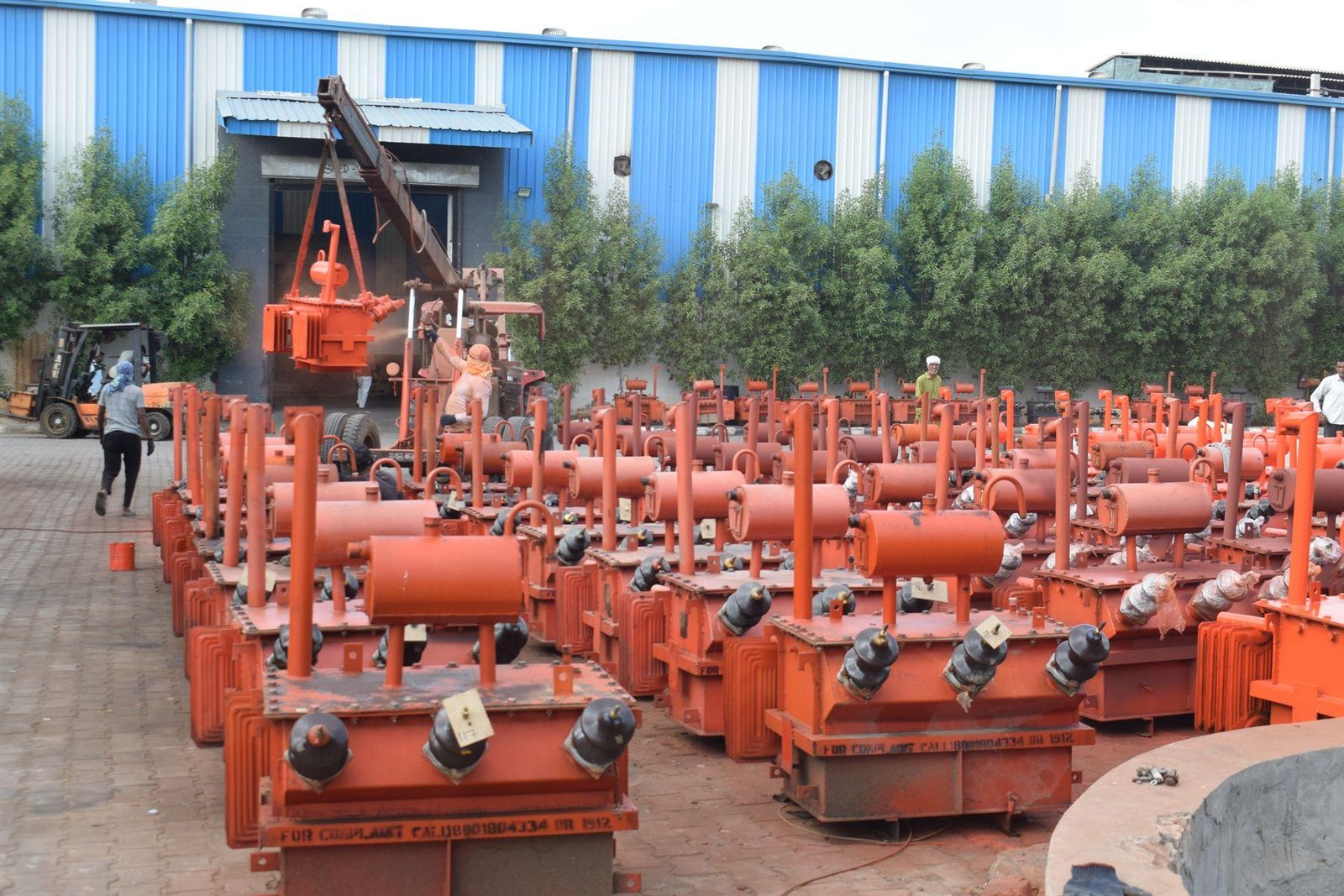
This sounds cosmetic and is not — it is a line-item rejection criterion at stage inspection. Specify the surface preparation grade (shot blast to Sa 2½), the interior and exterior dry film thickness in microns, the paint system, the shade number from IS 5, and the guarantee period against peeling and fading. Five years is the norm.
For export enquiries
Add three lines: the frequency (50 or 60 Hz), the applicable standard (IEC 60076 or the destination country's), and the ambient and altitude basis. And be aware that the Indian temperature-rise limits — 45 K winding and 40 K top oil over a 50 °C ambient — are materially stricter than the IEC 60076-2 baseline of 65 K and 60 K over 40 °C. A transformer built to the Indian limits is being held to a tougher thermal standard than an IEC specification demands.