
Supply · Ethiopia
Solar & Inverter Duty Transformers in Ethiopia
Up to 20 MVA. Manufactured in India to IS and IEC standards and shipped to Ethiopia: Ex Factory or FOB Mundra / Nhava Sheva; CIF Djibouti on request.
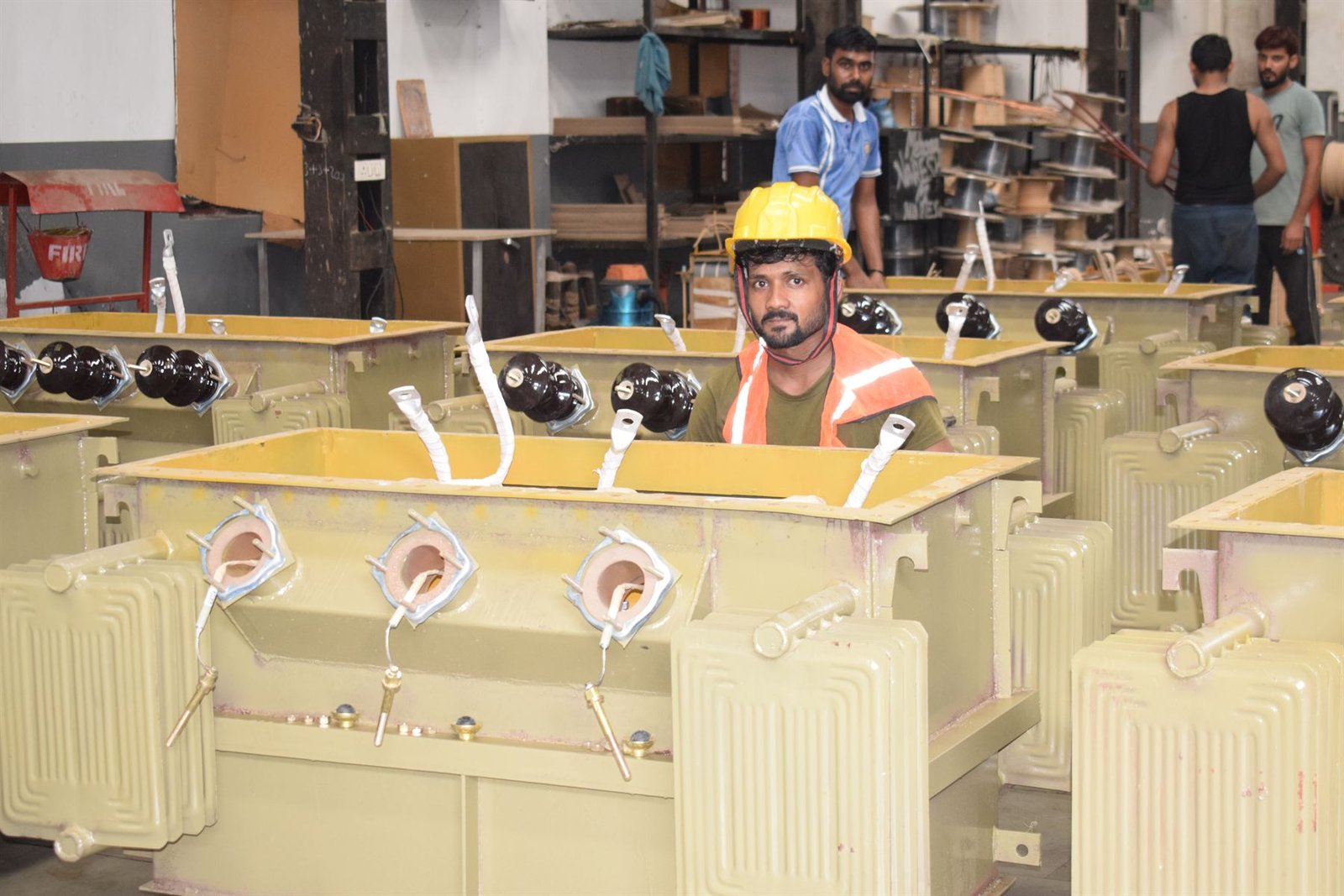
Tanks awaiting core-and-coil assembly
Logistics and network
Shipping to Ethiopia.
Consignments for Ethiopia move Sea to Djibouti (Doraleh), then road to Addis Ababa, about 900 km. Typical transit is 8 to 12 days to Djibouti, 3 to 5 days road; discharge at Djibouti (Doraleh), then road. We quote Ex Factory or FOB Mundra / Nhava Sheva; CIF Djibouti on request, with payment by LC at sight or advance, USD.
The grid runs at 50 Hz with 380/220 V low-voltage supply and 15 kV and 33 kV distribution (EEU reports over 54,000 km of 15/33 kV lines); 132 kV, 230 kV and 400 kV transmission. Distribution is operated by Ethiopian Electric Utility (EEU) for distribution and Ethiopian Electric Power (EEP) for generation and transmission, regulated by Ethiopian Petroleum and Energy Authority. Import conformity: ECAE Pre-Export Verification of Conformity: Certificate of Conformity valid six months, issued by an ECAE-authorised body; local inspection and testing for uncertified consignments.
The product
A solar transformer is not a distribution transformer with a different label.
An inverter feeds the transformer a non-sinusoidal current with significant harmonic content, and it does so on a duty cycle that is de-energised for roughly half the year. Both facts change the design.
Harmonic currents drive eddy-current heating in the windings that a standard design does not allow for, so conductors are transposed and the core flux density is de-rated to leave headroom. The overnight de-energised period means no-load loss dominates lifetime energy cost far more than it does on a distribution feeder — which is why the low-no-load-loss design is worth paying for here and not always elsewhere.
| Parameter | Specification |
|---|---|
| Rated power | Up to 20 MVA |
| HV voltage | 11 kV or 33 kV |
| LV voltage | 315 / 380 / 415 / 480 / 600 / 690 / 800 V — the inverter output, not 433 V |
| Winding arrangement | Two, three or more secondaries; dual secondary is the norm |
| Duty | Step-up, outdoor, solar or wind generation |
| Frequency | 50 Hz standard; 60 Hz for export |
Specifying
What changes for Ethiopia.
- Climate and site: Addis Ababa and the highlands at 2,000 to 2,500 m, altitude derating of insulation and cooling; hot lowlands at Dire Dawa.
- Built to IEC 60076 for 50 Hz, with insulation levels for the 15 kV and 33 kV distribution (EEU reports over 54,000 km of 15/33 kV lines) and 380/220 V secondaries; temperature-rise limits and cooling sized for the stated ambient and altitude.
- Fittings, bushings and tap-changer ranges follow the utility specification (Ethiopian Electric Utility (EEU) for distribution and Ethiopian Electric Power (EEP) for generation and transmission); type-test certificates from CPRI or ERDA accompany the offer.
- Documentation: commercial invoice, packing list, certificate of origin, test certificates and the import conformity certificate where Ethiopia requires one.
Questions
Frequently asked.
How long does delivery of Solar & Inverter Duty Transformers to Ethiopia take?
What documents and certificates come with a consignment to Ethiopia?
Which standard and voltage class do you build to for Ethiopia?
Send us your Solar & Inverter Duty Transformers schedule for Ethiopia.
Ratings, quantities, the specification you are buying against and the delivery point. We return a quotation with a firm delivery programme.