
Supply · Rwanda
Solar & Inverter Duty Transformers in Rwanda
Up to 20 MVA. Manufactured in India to IS and IEC standards and shipped to Rwanda: Ex Factory or FOB Mundra / Nhava Sheva; CIF Dar es Salaam on request.
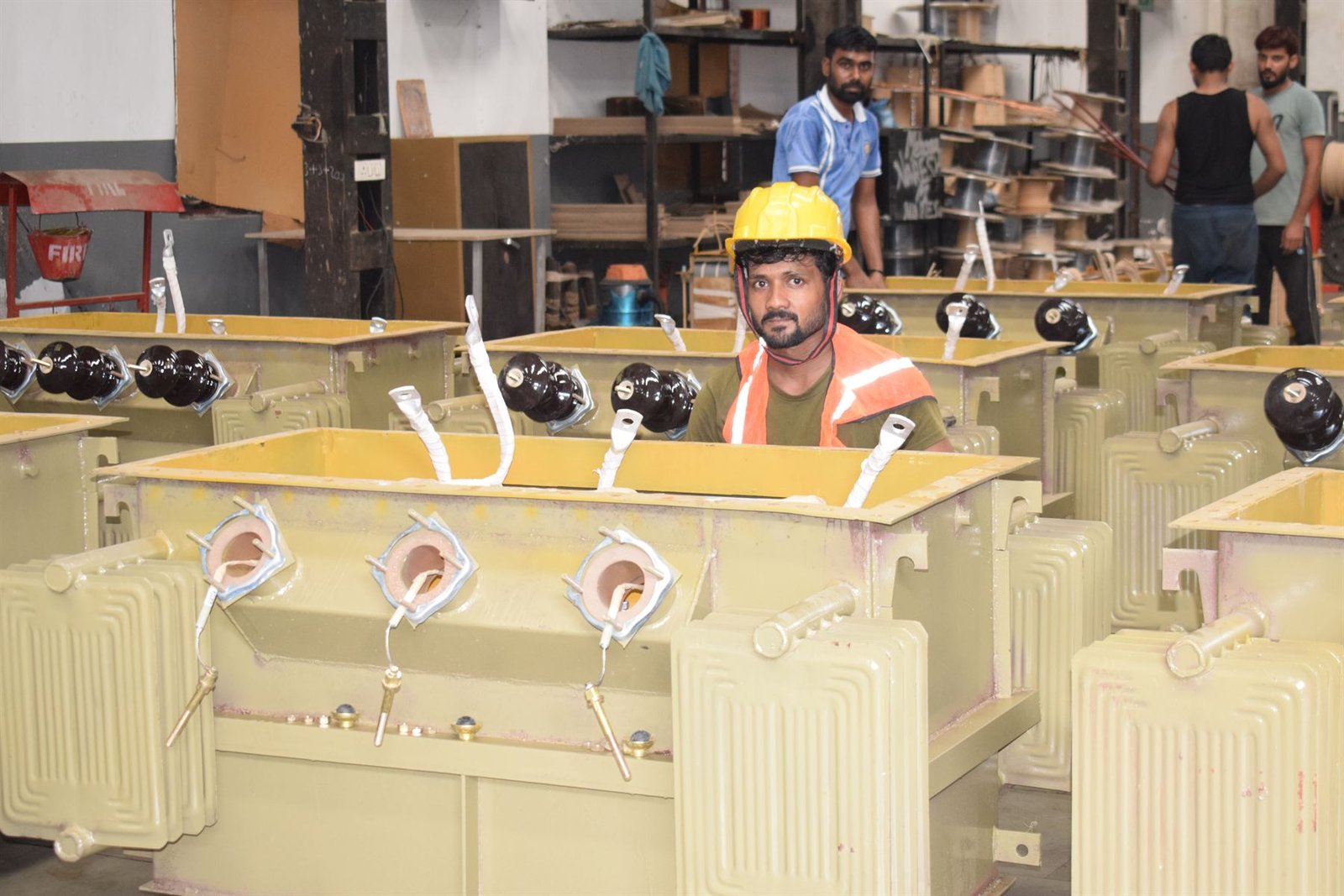
Tanks awaiting core-and-coil assembly
Logistics and network
Shipping to Rwanda.
Consignments for Rwanda move Sea to Dar es Salaam, then road on the Central Corridor to Kigali, about 1,400 km; or via Mombasa on the Northern Corridor. Typical transit is 12 to 16 days to port, 7 to 10 days road; discharge at Dar es Salaam or Mombasa, then road. We quote Ex Factory or FOB Mundra / Nhava Sheva; CIF Dar es Salaam on request, with payment by LC at sight or advance, USD.
The grid runs at 50 Hz with 400/230 V low-voltage supply and 30 kV distribution as the national standard, with 15 kV in Kigali and Rwamagana; 110 kV and 220 kV transmission. Distribution is operated by Rwanda Energy Group: Energy Utility Corporation (EUCL) and Energy Development Corporation (EDCL), regulated by Rwanda Utilities Regulatory Authority (RURA). Import conformity: Rwanda Standards Board (RSB) import conformity and REG reticulation standards; IEC designs.
The product
A solar transformer is not a distribution transformer with a different label.
An inverter feeds the transformer a non-sinusoidal current with significant harmonic content, and it does so on a duty cycle that is de-energised for roughly half the year. Both facts change the design.
Harmonic currents drive eddy-current heating in the windings that a standard design does not allow for, so conductors are transposed and the core flux density is de-rated to leave headroom. The overnight de-energised period means no-load loss dominates lifetime energy cost far more than it does on a distribution feeder — which is why the low-no-load-loss design is worth paying for here and not always elsewhere.
| Parameter | Specification |
|---|---|
| Rated power | Up to 20 MVA |
| HV voltage | 11 kV or 33 kV |
| LV voltage | 315 / 380 / 415 / 480 / 600 / 690 / 800 V — the inverter output, not 433 V |
| Winding arrangement | Two, three or more secondaries; dual secondary is the norm |
| Duty | Step-up, outdoor, solar or wind generation |
| Frequency | 50 Hz standard; 60 Hz for export |
Specifying
What changes for Rwanda.
- Climate and site: Highland, 1,500 to 2,000 m, 28 °C; altitude derating applies.
- Built to IEC 60076 for 50 Hz, with insulation levels for the 30 kV distribution as the national standard, with 15 kV in Kigali and Rwamagana and 400/230 V secondaries; temperature-rise limits and cooling sized for the stated ambient and altitude.
- Fittings, bushings and tap-changer ranges follow the utility specification (Rwanda Energy Group: Energy Utility Corporation (EUCL) and Energy Development Corporation (EDCL)); type-test certificates from CPRI or ERDA accompany the offer.
- Documentation: commercial invoice, packing list, certificate of origin, test certificates and the import conformity certificate where Rwanda requires one.
Questions
Frequently asked.
How long does delivery of Solar & Inverter Duty Transformers to Rwanda take?
What documents and certificates come with a consignment to Rwanda?
Which standard and voltage class do you build to for Rwanda?
Send us your Solar & Inverter Duty Transformers schedule for Rwanda.
Ratings, quantities, the specification you are buying against and the delivery point. We return a quotation with a firm delivery programme.